

Ruacana Falls – On The Brink of Angola
Angola Part 1 – April 2025
I’d long harbored an interest in Angola, mostly from sitting in camp Syncro on the south bank of the Cunene River in Namibia, looking across the water at Angola’s looming mountains on the opposite bank. This pull, a few stories from friends, and Paul Theroux’s The Last Train from Zona Verde all nudged us north towards the border. The scant information called to us. That and diesel at thirty cents a liter.
Our trip by the numbers
- Average speed between Ruacana border to Flamingo Lodge via Iona: 15.6 kph
- Fuel Consumption: 5.2 km/l – I attribute this appalling number to being heavily loaded, a lot of driving in sand, some dune driving, and a lot of time in low-range 4×4. Normally we’re around 6-6.5 km/l.
- Cost of diesel in Angola: 0.33 USD/liter
- Total distance: 1749 kilometers in Angola
- Number of nights in Angola: 14
Things came together relatively last minute. It happened that we were able to get time off from work in April, just after the biggest rains Namibia had in many years. Our hope was that some of this rain had extended into Angola’s piece of the Namib desert, contained within Iona National Park, and we’d get to see the landscape alive with wildflowers, grass and perhaps even some of Iona’s beleaguered wildlife.
Other travelers’ reports of Iona often recount a slow road into the park from the east, and either a turn north at the headquarters of Espenhierra or a dash to the Foz Do Cunene before retreating north out of the park via Espenhierra. Some brave the beach from Foz Do Cunene north, the so called “Death Acre” which requires driving many kilometers of tide dependent beach. This is usually done in a group and with a guide, of which we would have neither.
Of the rest of the park, little is written or shared. Our aim was to explore as much of this as we could.
The park is huge, at ~15,000 sq kml. There is no gate when entering from the east. There is no water, no food, no fuel. Just a few villages and tracks in the wilderness. The campsites are GPS coordinates, but when you arrive, you’ll find only a place to be, no facilities of any kind, barring some very modest facilities at a single site, Gruta do Leo. The digital maps for a GPS are sparse, and save the main road in, to the Foz, and the road out to the north gate, many tracks are missing. The tracks that lead to the real sights are in the blank space on the GPS.
Preparations
Our preparations were similar to our other trips. Jenny stocks a pretty extensive first aid kit and has wilderness first aid training. We carry a satellite phone, backup paper maps, and backup offline navigation on our phones. Primary navigation was performed on a Garmin 276cx with T4A’s latest map set, which has more detail than in previous editions. We also have the free OSM maps on the 276cx, which occasionally have roads not shown on T4A. In addition, a friend had just been to Iona and had sent me his GPX tracks, and lastly we had African Park’s recently published map as a .pdf. While simple, the new African Parks map proved invaluable.
The Cruiser had been at a shop for a once-over and some alterations. Chiefly, we had new suspension installed. This may have been somewhat financially irresponsible. The old suspension had almost 100,000 kms on it, but it was still functioning. But it seemed ever so harsh, and on our last trip, the corrugations on some of Namibia’s C roads, as well as the sandy undulations of Khaudum National Park, left me with the impression that there was serious room for improvement.
We settled on Terrain Tamer parabolic leaf springs with 62mm shocks from Outback Armour, as recommended by Safari Engineering in Windhoek. In addition, I finally caved and asked for wheel spacers to be installed. The spacers correct the 45mm track difference between the front and rear axles on the 70 series Cruiser. I have long ignored the Cruiser wonks who consider these essential, but again, the sandy tracks of Khaudum convinced me it was at least worth a try. In deep sand, the back of the vehicle shifts from side to side as the rear wheels try to find the track of the wider front wheels. These simple spacers solve this issue. Cruiser fanatics debate passionately on whether this places stress on the rear wheel bearings that causes pre-mature failure. We have taken the leap, and I guess we’ll find out. Jenny remains unconvinced that these are an improvement.
Iona is hard on tires, and we have some BFG KO2s with something over 20k miles on them, along with two spares and various tire repair kits.
Distances are not particularly vast in Angola, but fuel stations are few and far between, the tracks are in poor condition, and the going is slow. We have an auxiliary Brown Davis long-range fuel tank, giving us 110 liters of extra capacity (maybe 105 in reality), as well as 80 liters in jerry cans. This, combined with the stock main tank at 130 liters, gives us ~315 liters of fuel. Even if we are driving in low range and sand and getting appalling fuel economy, it should give us 1,600 kilometers of range. Originally, when we got the long range tank we vowed to dispense with the jerries, but with Angola ahead we thought we’d keep them for a bit longer.
We Begin
We flew into Windhoek with a mission to pick up the Land Cruiser and beeline it for the border. Namibia’s new visa rules had come into effect just over a week before. We had applied online ahead of time. At the airport, there was some minor fuss in the crowd to figure it out, but it didn’t take any longer than usual to get through. After explaining our plans and that we’d be departing Namibia in just over 30 days, we were granted a 90-day multiple-entry visa instead of the usual 30-day visa.
As is our usual program, we stay at Urbancamp in Windhoek. We, and Jenny in particular (I am invisible) have been here enough that she is greeted with a hug and smiles upon arrival. Jenny has a connection with one of the senior staff, whose husband also works at sea, and it is wonderful to have a friendly face and the familiarity of this place to return to. Our car had been dropped off by Safari Engineering at Urbancamp, and the keys were waiting for us at reception.
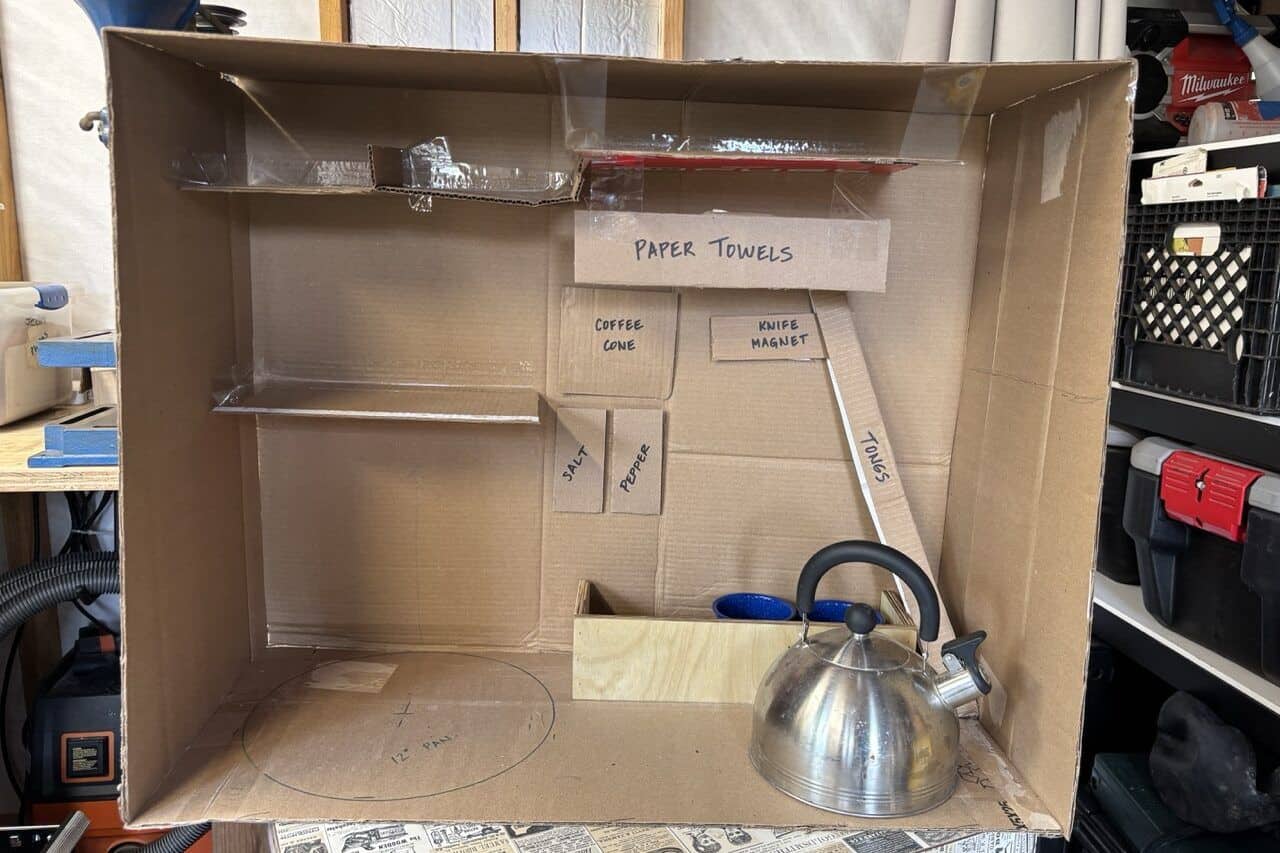
Our last improvement was an upgrade to our camp kitchen box. This would be the 3rd generation for us. When we got the new canopy we decided to try a new kitchen box with a lift out floor, where we could stow the house battery underneath and get it out of the engine bay. The first version of this concept was a bit of a false start, I will spare you the frustrating details. This time around, we had the proper box installed by Safari Engineering, but we are particular and elected to do the inside ourselves. Jenny had made the various shelves, brackets and cutlery holders all at home, and we packed them all in our luggage. A day was spent at Urbancamp drilling, bolting and riveting all in place. It is not quite perfect, but a huge improvement from what we had before.

We have Windhoek pretty dialed for gearing up for a trip, and now we rarely have to leave the Eros neighborhood. We provision at the Woermann Fresh supermarket in Eros. Good quality firewood is available on the side of the road just south of Urbancamp, and we buy nice coffee at Miena’s Market near the closest Spar. After this flurry of activity, we had provisioned, fueled and watered, and finished our kitchen renovation.
To Ruacana
The chores done, we hit the road and made a hop of a few hours to the campsite at Otjiwa. We have stayed here before and found it top notch. This time, the prime campsites (No. 1-3) were taken, and we were relegated further back, but it was still good. It had clearly recently rained hard, and the road in was slick as an ice rink. This gave us some pause, for if the Cruiser was sliding around on the road into Otjiwa, a quite fancy property, how would things be north of the border? The campsites here normally look at a dry riverbed, but instead, there was a lake that had half consumed camp 5, another ominous sign.
This first night camping was a tremendous relief; we felt we could finally exhale. The last few months of home life, or two years depending on how you count it, had been stressful, and to be out camping in the bush was proof that that chapter had come to a close. What a tonic.
After savoring a night of camping and a morning in camp, we continued the push north. The Spar in Outjo was our final provision top-up. Sadly, the Outjo bakery was out of our pepper steak pies, and we suffered through ham and cheese, not really up to snuff.
We were continually impressed with how green everything was. We’ve been seeing in the news and hearing from friends about all the rain, but it is a whole other thing to see it in person. Green grass along the verge and there were dense green leaves on every shrub, and tall grass where in the past there would only have been red dirt.
As we headed north on the C35, the turn to Opuwo went by on our left and it was now new territory for us. It’s pretty much mopane scrubland, but once we got to Ruacana town, we saw dispersed settlements, people walking the road, goats and villages here and there. Turning towards the falls held some anticipation; we had heard they were absolutely pumping. The scenery takes a decisive turn here and becomes really beautiful. The road drops down a steep escarpment with wonderful boulders scattered along the hills, heading towards the falls. The reservoir and dam hove into view, and we could see spray rising high into the air from the falls.
We were not disappointed. One of the flood gates was open on the dam, and after probing the tracks, we found the viewpoint adjacent to the power plant and got to witness the falls in all their splendor. What a sight! It was truly impressive – tumbling, frothing rivers of water all along the face, with spray everywhere.
Some Namibians were also there, enjoying the view, and they were very excited to see the falls in such a state. It’s always a good sign when the locals are enthusiastic too.

A note on visiting Ruacana Falls
There are two places to view the falls from the Namibian side. For both of them, you take the turn toward the border post. For the first viewpoint, after turning for the border, take the first left, toward the power plant, and then you’ll see a small area to park to the right side of some hydro-electric plant infrastructure. Park and walk 10 meters, and there you are. It is unmarked.
The second viewpoint is in no-man’s land between the border posts. Continue on to the Namibian border post and ask the authorities if you can proceed to the falls viewpoint. They will give you permission, and you drive straight to the viewpoint (there is a sign), which is about 300 meters away. There is a parking area, a few picnic benches, and a modest bar/café. A few steps down, on the left side of the parking area, will bring you to a viewpoint. The one by the power plant gives you a more expansive view, the official viewpoint between the borders is closer to falls. Both are impressive.

After viewing the falls, it was time to find a place to camp. I’d messaged a new campsite, Raycana campsite, and they said they might be able to exchange some money for Angolan Kwanzas for us. The river was in flood and so high that some of the riverside camps were flooded, and Raycana is situated on a hill and clear of the water, so it seemed it would tick all the boxes.
It’s 8 kilometers from the falls, and the rain had not been good for the road, so it took longer than expected. The campsite is at the top of a hill overlooking the valley. There is a bar area, a pool with a view, and six camp pitches close together. Each campsite has its own ablutions.

Getting Kwanza was causing some anxiety. We planned to use the Ruacana border post, in keeping with our preference for small borders, and this was closest to our goal of Iona National Park. However, there are no banks or ATMs between that border and the park, and the park only accepts Angolan Kwanzas or international wire transfers. Since we were not sure of our exact dates or duration of stay, we had avoided pre-paying via wire. However, Kwanza was not even allowed to be traded outside the country until fairly recently, and this, combined with the frequently fluctuating value, means that, practically speaking, you can’t get Kwanza outside of Angola.
It turned out that Raycana did not have Kwanzas to trade today, but they seemed confident that we’d find someone at the border to exchange money on the black market. We were advised to look for the young men carrying backpacks.

It had been something of a whirlwind to get from America all the way to the Ruacana border, so against our better judgment, we let ourselves have a relaxed morning before heading for the border. We made the journey back east, and all the way to Ruacana town to top up on fuel prior to heading to the border. It is 20 kilometers past the border to the fuel station, so this took up a bit of time.
With that, we turned at a faded road sign saying “Angola —>” and headed for the unknown.
Highlights
- Ruacana falls in full flood. Stunning!
- Lovely views driving down the escarpment to the falls, and from Raycana campsite
- Back on the road again!
Lowlights
- Appalling fuel economy of a heavy cruiser
- Difficulty in getting Kwanzas, though totally expected
Questions or comments? It’s great to hear from readers. Please comment below, and I’ll try to respond as soon as possible!
Ruacana
Raycana Campsite is actually in two locations: a brand new riverside camp and the hillside camp we stayed at. Camping was $N350 pppn. While the camp had a lovely view and a pool, each of the pitches was close together. The camp has well tended landscaping and looks great. There is an excellent sundowner spot with picnic tables and a shelter, a couple of minutes’ walk from camp.
Ruacana Puma Station does accept credit cards. Additionally, they can act as an ATM of sorts, swiping your card at the register and then dispensing Namibian dollars in exchange. Fair warning, though – they charge a high fee – $N250 for this service. But there is no other choice. The shop in the Puma station is quite well stocked for a small shop, including ice (usually) and some frozen meat.
There are a few roadside vendors selling wood on the side of the road as you drive into Ruacana town towards the Puma station. We paid $N20 per bundle of good mopane wood.


What a nice surprise to see the two of you back in Africa, and exploring parts unknown. I’ll happily read along as you conquer new territory like true pioneers. And Jenny made her own shelves? Wow. Impressive.
We are visiting tamer places and in a few days will be in Kruger, Serengeti, Tarangire, and Amboseli. Can’t wait to see my animals…
All the best and excited to see the blog active again.
Katrin
Hi guys, I love reading your blog as avid off road travellers of Southern Africa, based in Johannesburg. We’re seriously planning an early retirement next year to explore more and see more of Africa. Please keep sharing, and if you ever need another SA contact, please feel welcome
Hi there, we’re enjoying your blogs and find the information really helpful, thanks. We’re planning on an early retirement to further our Africa travels. We’re avid off-road campers based in Johannesburg and have travelled a bit of Southern Africa but keen to do more and see more! Please keep sharing, and if you need another SA contact, you’re always welcome to get in touch. Safe and happy exploring!
Thanks! It’s always great to hear from readers and I’m glad to hear there is some useful info for you.
Thanks. Looking forward to the Angola part… Like you, I thought it looked really cool from across the Kunene at camp Synchro, so it is on the radar.
Thanks for sharing your trip here, really enjoy reading up.
Yeah, what is it across the Kunene, that was also my question over time when doing the Ruacana to Epupa leg over many years.
Now Iona, yes, can’t wait to see more through your lenses.
Thanks for the kind words Walter. Is is a burning question! Now, a bit of it I can answer, stay tuned.