

We Quit Our Jobs and Bought a Troopy
Feb 9th, 2026
“To be truly challenging, a voyage, like a life, must rest on a firm foundation of financial unrest. Otherwise, you are doomed to a routine traverse…” – Sterling Hayden, Wanderer
Perhaps foolishly, we’ve both left secure employment for the unknown. The goal is to spend more time traveling Africa, and to have more time to dedicate to family, friends, and health.
That is all well and good, but what are we actually doing and how are we doing it? I write now from Kommetjie, South Africa, a beach suburb on Cape Town’s southern peninsula. We are here welcoming a new addition to the family, a Land Cruiser 78 Troop Carrier, aka a “Troopy”, so called because they are often used by the military or police to carry troops. Sadly, this means we’ll have to sell the Honey Badger, our long-serving 79 series Cruiser.
The Honey Badger has been a loyal companion for 120,000 kilometers through Africa, but we have learned over time that for long term travel, we’d benefit from the ability to retreat inside once in a while. Jenny and I have forgone dinner to sit in the cab reading books while wind and sand whip around the car in the desert, or have eaten a meal of cheese and crackers in our roof top tent while waiting out torrential rains.
The Troopy
A Troopy will also give us some modicum of privacy if we’re camping in more densely populated areas, or, if it’s been raining, the chance to get out of wet clothes before climbing into bed – a luxury not afforded by a roof top tent that you enter from a ladder on the outside.
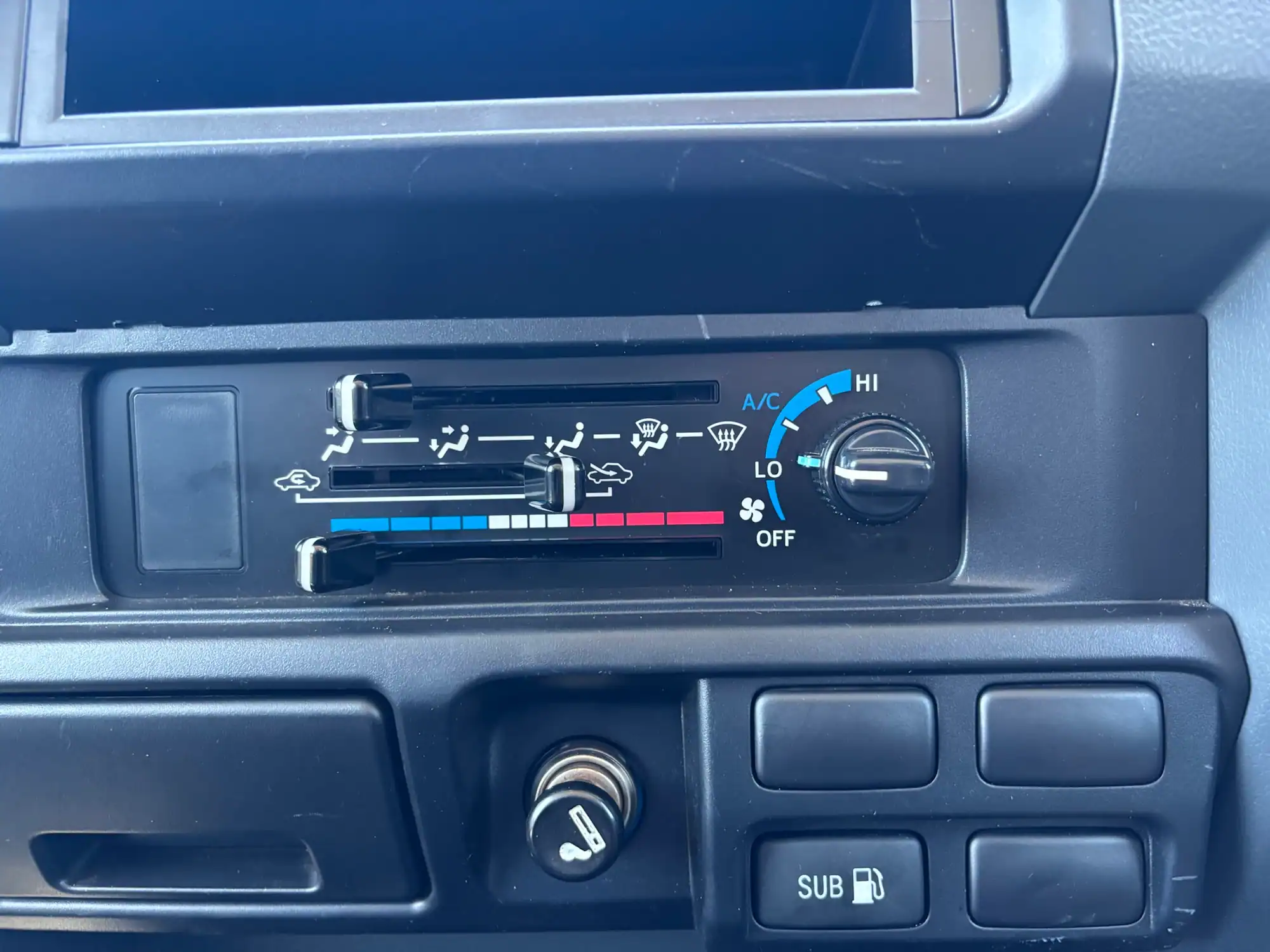
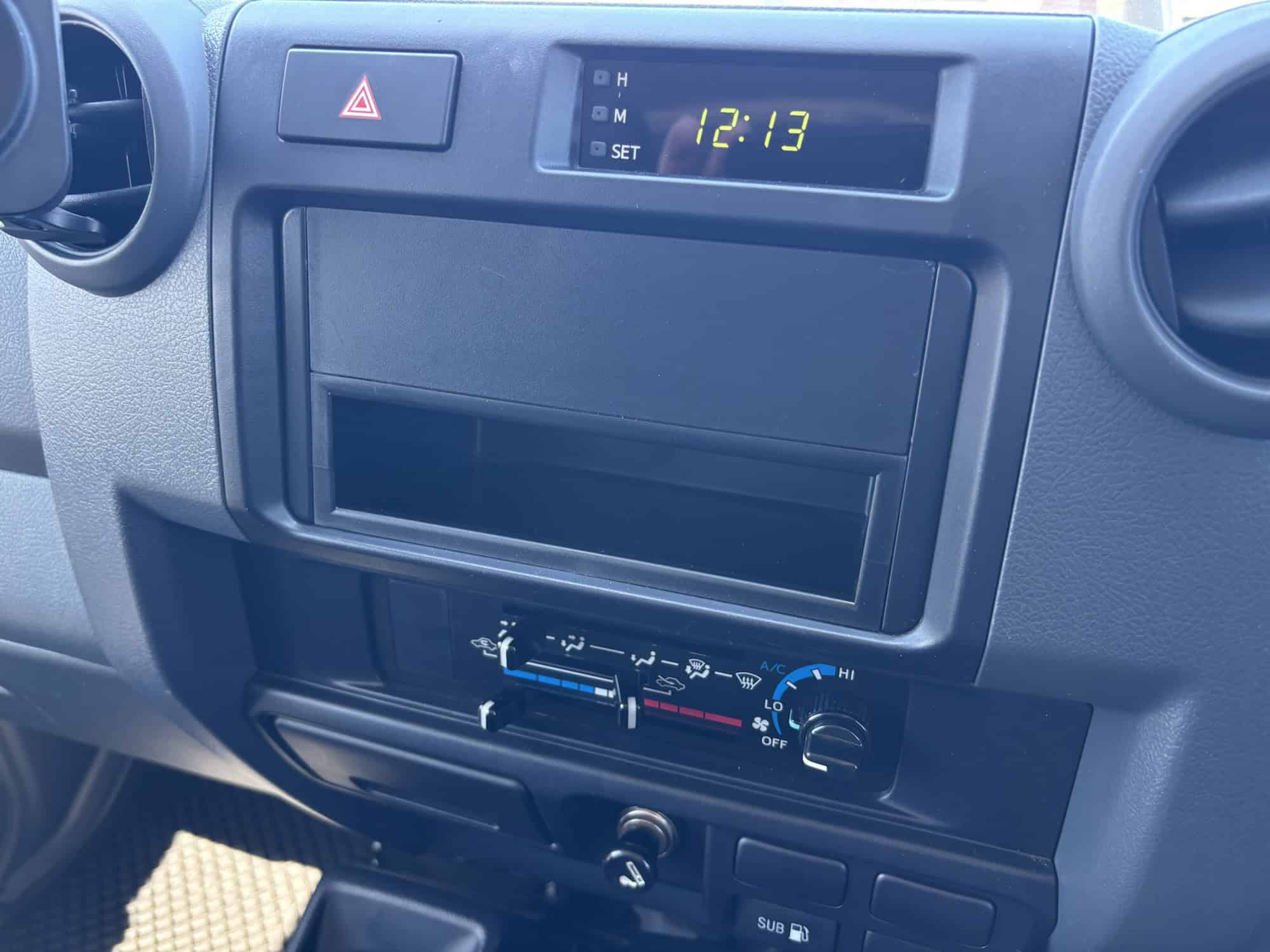
To the uninitiated, a Troopy is a 78 series Land Cruiser, while the double cab pickup is a 79. This means that otherwise, the vehicles are pretty much the same. For those that hark for simpler times and vehicles that aren’t like rolling computers, this is the vehicle for you. Remarkably, this model year 2022 Troopy has features that are cutting edge. In 1990. Such as:
- Solid axles front and rear. The axle housings are the diameter of trees.
- No factory radio at all – just a plastic blanking plate.
- The 1HZ engine is naturally aspirated with a mechanical fuel pump.
- “Four on the floor” – a low-range gearbox with that second stubby lever down low, not a push button on the dash.
- Factory front and rear differential locks.
- Ash tray included.
- One cup holder. Clearly, this is a work vehicle and not designed for couples.
- No armrests.
- Some luxuries have been added; it has air conditioning! Power Locks!
- No audible beep when you don’t buckle your seatbelt, open the door with the keys in the ignition. We told a friend about this, and he looked at us in disbelief – “That is freedom,” he said with longing. He drives a Tesla.
There are a thousand vehicles more refined and more comfortable, but this simple workhorse is unfussy about fuel quality, road quality or pretty much anything else. Because of these traits, there are thousands of 70 series Land Cruisers throughout Africa, used by the safari industry, police, military, rebel forces and NGOs alike. A 70 series Cruiser is a bit like lingerie; you pay more to get less.
How are we doing this?
Enough of all that. How does one cast off the yoke of employment and jaunt around Africa in an expensive yet archaic vehicle for the heck of it? Family money? No. Stock options from high powered jobs in tech? No. Just the usual way, the boring way. We spent less than we earned and saved a lot of money. We were both fortunate to work in niche fields and had good jobs, and by buying less house than we could afford, we were able to keep our old condo and rent it out. While we’re over here, we have rental income, savings, and will also do some part-time/contract work for our old jobs. That’s the secret recipe. Let’s hope it works.
What is the plan
When we bought the 79 series Cruiser in 2017, we bought it used from a rental company, and it came all set up to travel and camp from day one.

In that car, we spent one night in a guesthouse and then drove away and camped for the next three weeks. This time around, the Troopy is a blank canvas. With only 25,000 km on it, basically a new car and more or less stock. The only modifications it has are a bull bar, rock sliders, and off road tires – BFG KM3s, 235/85/R16s. Not 285s, we’re not animals.
To buy it, I found the car online and had an agent check it out. They test drove it, had a 3rd-party inspection done, and made a final recommendation. We made the purchase via Wise (more or less a wire transfer, but with a better exchange rate. Referral link here), and our buyer handled the registration.
Last September I flew into Joburg, picked up the car and drove it straight to Cape Town to Alu-Cab to have the roof chopped off and a roof conversion installed. If you’re unfamiliar with these – think a Westfalia type camper van pop-top, as opposed to the roof top tent that just bolts to the top of the car. This is the critical feature that allows us to transform the Troopy from a utilitarian bush taxi to a small off-road camper.


South Africa is perhaps the best place in the world to get this sort of work on a vehicle done. Workshop rates are inexpensive, and some of the best 4×4 products are made here.
Arriving in Cape Town in late January, you’d hope that we had a whole plan in place to get the car converted to bush-ready ASAP. We didn’t. We have a good idea of what we want done, but this is a sizable project, and the vendors that do this sort of work here are not big on email and remote customers.
Walk through their door, and they’re great. But try to plan an overland vehicle build remotely – near impossible (we tried). A cottage industry of 4×4 vehicle consultants is borne out of this inefficiency, and you can pay a sort of 4×4 general contractor to manage this for you. This service is expensive and doesn’t always go according to plan, so we’re doing this ourselves.
Tales of vehicle builds gone wrong are many. We heard of people who dropped their car off at a reputable shop in April and it was still not done in October. Another went to a famous 4×4 outfitter and has had their vehicle there since October, and it is still not done in February, and what has been done has been sub-standard. Dangerous electrical installations are common, we know of one person who’s vehicle caught fire and burned completely, a total loss, due to an uninsulated wire installed without a fuse. Patronizing shop owners telling us what we want are many, and delays are near certain.
Not all adventures in Africa are elephants and river crossings. Instead, we’ll be navigating the scrum of traffic in Cape Town, haggling over build details, prices and schedule in the industrial part of the city and running a million errands.
Our daily lives look a lot different here than they do on our usual trips in the bush. We’re staying in a lovely cottage near the beach, courtesy of Jenny’s good friend Sarah. For the time being, we are house and dog sitting while Sarah is away. The two terrors that run our lives are Stan and Steve, two Jack Russells full of personality.


Kommetjie, our little beach suburb, started long ago as a small fishing village and spot for weekenders to visit from Cape Town. Now there’s no commercial fishing and it’s pretty much a surf and beach spot, primarily for South Africans, though some international tourists also find their way here. Here in the Cape’s “Deep South”, as it is known, there is a boho vibe behind the lentil curtain. It is a part of Africa very different from most of the country and the Africa we’re familiar with further north. Oat milk lattes and vegan menus abound. The Mediterranean climate is lovely, though the Cape’s famous blustery wind is common.
To get to Cape Town, where most of the 4×4 outfitters and vehicle shops are, it means a trip “over the mountain” via Oukaapseweg, a winding pass over a saddle in the Steenberg mountains. Going over the mountain is something of a commitment to leaving the bubble of the Deep South and diving into the grittier side of Cape Town. Instead of the haunts of pretty people and tourists at Sea Point and Camps Bay our stomping grounds have become Ottery, Brakenfell and Stikland, where suppliers, workshops and warehouses abound.

We landed on January 21st. We hope to be camping in a mostly converted vehicle by the end of March. Is it possible? Stay tuned to find out.


FYI: there are no support links, just text. At least they don’t show up on my Android phone. I assumed that you meant to put links there.
Whoops! I will look into it. Thanks for the heads up!
Hi Andrew and Jenny!
You guys are such brave and unconventional people! Very impressive to quit normal life and start another even greater adventure!
Best of luck outfitting your Troopy. I hope it will turn out just the way you imagine it.
Once on your way, I’ll be happily following you along.
As for us, we are traveling frequently in our RV around the States and Canada. Going to Kruger in May, the Pantanal in August for Jaguars et al and in November to Manitoba for polar bears et al. All tame places compared to what you’re planning.
Is the Congo on your list? West Africa?
All the best and fingers crossed from Katrin and Phil
Hello Katrin – very nice to hear from you and thank you for the support! So glad to hear you are still traveling far and wide, sounds amazing.
Yes, West Africa (inc. the Congos) is on the list. We’re thinking 2028, but TBD.
Best of luck with your vehicle fitting and future travels. We are so happy for you, living your dreams. And looking forward to read about your further African adventures. Safari njema!
Thank you! We’re very excited, and a bit nervous for this big step, but now seemed like the time. I’m sure we will share a campfire sometime in the future and catch up.
So wonderful-
We look forward to hearing about every minute! Cousins Joyce and Mark
Congratulations on the transition. So i can assume the Troopy doesn’t have heated seats?
Building a tricked out off-roader should be a dream project for you two.
Thanks Chris! Ha – no heated seats. Vinyl all the way! (aftermarket seat covers essential). It is very exciting to do the troopy project, but also eerily reminiscent of being in the shipyard – vendors late, promise what they can’t deliver, etc. So much cajoling to get it done, at times it makes us wish we could do it more slowly at home with all our tools in the shop.
So great to here about your new plans and excited for you both. Good luck with bulding your dream camper! Will follow you and probably we will meet somewhere in Southern Africa as we will also be on the road quite a bit this year.
Vanessa from Switzerland
Thank you! I hope we see you on the road.
Greetings from Joburg. I am green with envy but so excited follow the next leg of your adventures esp. the Congo’s. Good luck finishing up your build and enjoy the Cape so long. Best, Dana & Deb.
Thank you both! We are excited, and very anxious to get out of the city and into the bush. And I see the Congos stop is already taking on a life of it’s own!
Congratulations on taking the plunge. Looking forward to see the fit out and following your travels. Timely post